
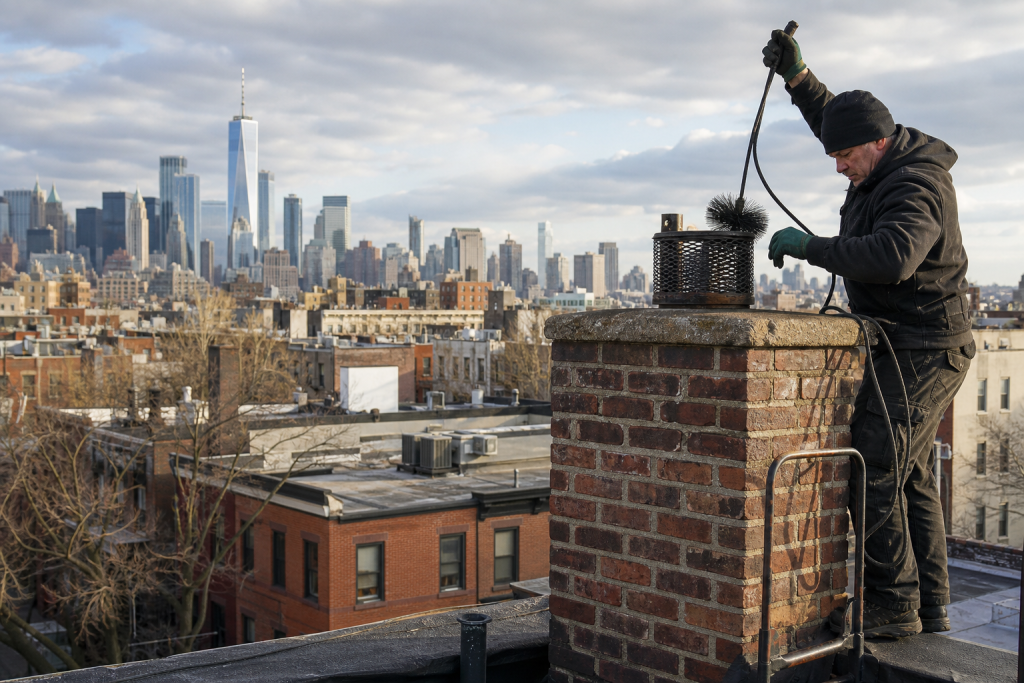
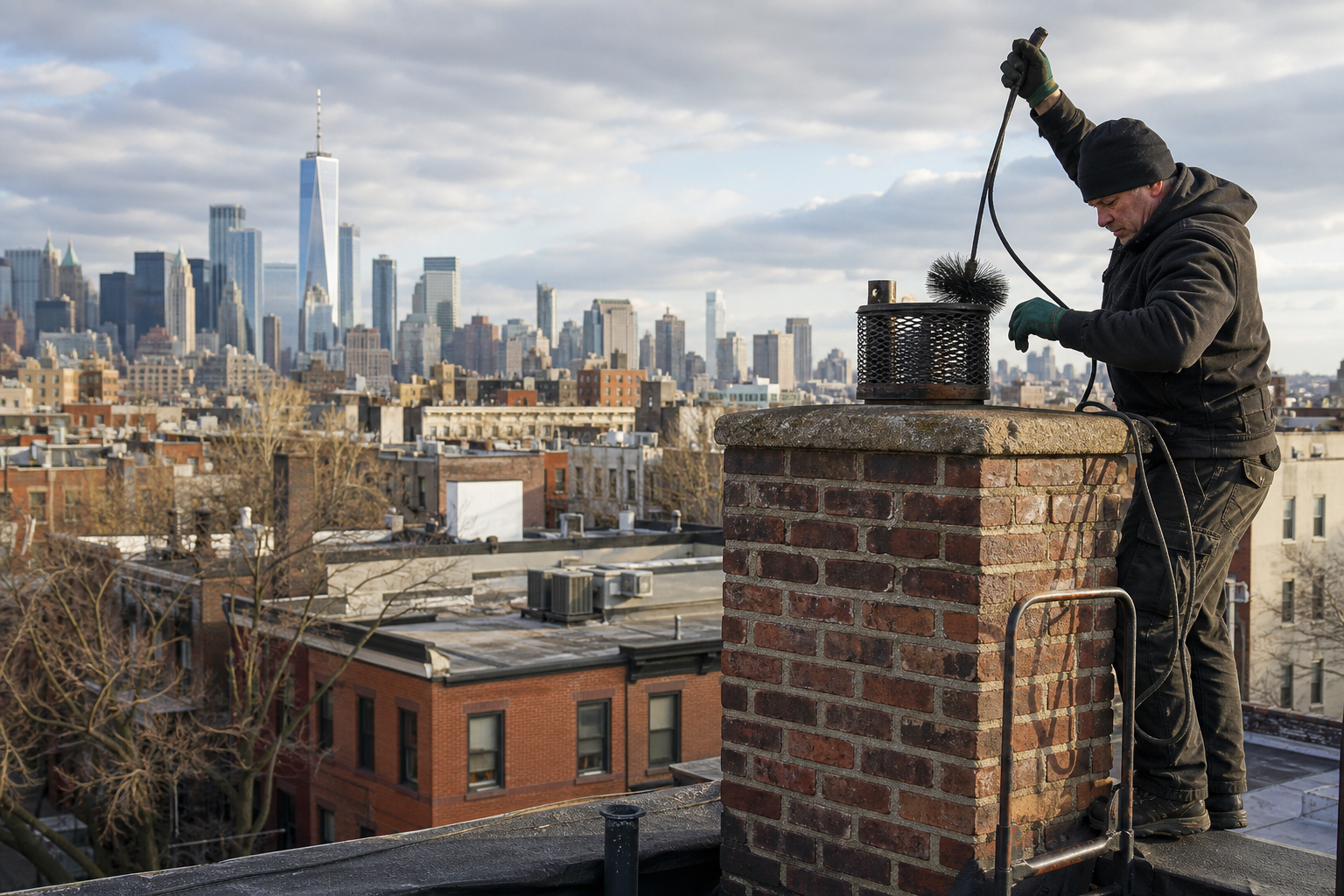
HeatShield Chimney Cleaning & Sweep in New York City: A Homeowner’s Guide
HeatShield chimney resurfacing in New York City typically costs $2,800–$5,500 for a standard flue and extends liner life by 15–20 years when applied to the right candidate. It’s the wrong choice for flues with structural shifting, spalling tile deeper than ⅜ inch, or active water intrusion — conditions we see weekly in pre-war brownstones where a full stainless liner is the only safe repair. If you’d rather not guess whether your flue qualifies, call (833) 349-5892 for a camera inspection and honest assessment.
Here’s the mistake we correct most often: a homeowner in Chelsea or the Upper West Side pays for HeatShield after a sweep told them their flue was “fine for resurfacing,” only to discover six months later that the underlying clay tile was too far gone to hold the sealant. HeatShield can add 20 years to a deteriorating clay flue liner — but only if the chimney is cleaned and assessed correctly first. Used on a flue with active cracks beyond its application threshold, it’s an expensive bandage on a structural problem.
At Legacy Chimney Cleaning New York, Paul Torres leads every job personally, and in 14 years we’ve learned that HeatShield is one of the most effective resurfacing systems available for damaged clay tile flues — and one of the most misapplied, because it requires precise surface prep and liner condition assessment that most sweeps in New York City skip.
What HeatShield Actually Is — and What It Isn’t
HeatShield is a cerfractory flue sealant — ceramic refractory, specifically — designed to resurface the interior of clay tile flues that have minor to moderate surface degradation. It’s not a liner replacement. It’s not a structural repair. And it’s absolutely not a solution for flues with displaced tiles, significant mortar loss, or combustion gas leaks into wall cavities.
The product forms a smooth, insulated layer that restores the flue’s ability to contain heat and corrosive byproducts. When properly applied by a certified technician, it carries a 20-year warranty. That “properly applied” clause matters enormously, because HeatShield’s warranty is contingent on pre-installation cleaning, specific surface preparation, and application thickness standards that many contractors in New York City treat as optional.
We’ve inspected flues in Gramercy Park and Park Slope where a previous contractor skimmed HeatShield over soot-caked, cracked tile. The product failed within two seasons. The homeowner paid twice: once for the bad job, once for us to remove the failed coating and install a proper chimney liner replacement.
Key distinction: HeatShield resurfaces. It does not rebuild. If your clay liner has lost structural integrity — tiles that shift when probed, mortar joints eroded past ½-inch depth, or visible gaps between tile courses — you need a stainless steel liner from a brand like DuraFlex or Olympia Chimney, not a surface coating.
When HeatShield Is the Right Call for Your NYC Chimney
In our experience across New York City’s housing stock, HeatShield suits a narrow but important category of flues: those with surface spalling, minor cracking, and intact mortar joints where the clay tile itself remains structurally sound. Think of it as repointing brick versus rebuilding a wall — the substrate must be sound.
Visual markers that suggest HeatShield candidacy:
- Small hairline cracks in tile glaze, no wider than 1/16 inch, with no displacement
- Surface flaking or spalling less than ⅜ inch deep — shallow enough that the tile body remains solid
- Mortar joints intact when gently scraped; no powdering or voids deeper than ¼ inch
- No evidence of combustion gases escaping into surrounding masonry (staining on exterior chimney face, odors in adjacent rooms)
- Chimney crown and cap in functional condition — HeatShield won’t stop water from ruining a flue if the top remains unprotected
The pre-war buildings dominating Manhattan and Brooklyn complicate this assessment. Original flues in 1920s six-story walk-ups often used lower-fired clay tile with thinner walls than modern standards. We’ve found flues in Greenwich Village where the tile looked superficially sound but had developed micro-fractures from decades of thermal cycling. Camera inspection — not a flashlight glance — reveals the difference.
Paul Torres performs every camera inspection himself, grading flue condition against HeatShield’s published application standards. If we’re uncertain, we recommend a stainless liner. The cost difference stings once; a failed resurfacing stings twice.
When a Full Liner Replacement Is the Only Safe Answer
This is where most New York City homeowners get steered wrong. HeatShield is profitable to install and easier to sell than a $4,000–$7,000 liner replacement. Unscrupulous or undertrained sweeps apply it to flues that need structural intervention.
Conditions that disqualify a flue from HeatShield candidacy:
- Tile displacement or shifting — any movement when the tile is tapped indicates the liner has lost structural unity
- Spalling deeper than ⅜ inch, exposing the porous tile body or creating pockets where creosote accumulates
- Vertical cracks running full tile length, especially those that align with mortar joints — these indicate thermal or structural stress beyond surface level
- Evidence of chimney fire damage: tile discoloration (white or orange staining), warped metal components, or thermal shock cracking patterns
- Water-saturated flue systems: in New York City’s freeze-thaw climate, water intrusion accelerates liner degradation and prevents proper HeatShield adhesion
- Previous liner repairs with incompatible materials — we’ve found Portland cement patches that must be fully removed before any resurfacing
Last winter we inspected a flue in a Crown Heights brownstone where a competitor had applied HeatShield over tiles with ¾-inch spalling and active water staining. The homeowner smelled smoke in their second-floor bedroom — combustion gases were migrating through the degraded liner and into the building’s balloon framing. We installed a full DuraFlex stainless liner with proper insulation and a Gelco cap. Problem solved, but only after the wrong solution failed.
When your flue shows these disqualifying conditions, chimney repair with a full liner replacement isn’t the expensive option — it’s the only option that won’t endanger your household.
Why NYC Pre-War Buildings Demand Special Assessment
New York City’s housing stock presents unique challenges that generic HeatShield training doesn’t address. The original flue construction in pre-war buildings — roughly 70% of Manhattan’s residential inventory and significant portions of Brooklyn and Queens — differs materially from suburban construction where most product development occurs.
Specific factors we evaluate in NYC pre-war flues:
- Unlined or partially lined flues: Many 1890s–1930s buildings were built with brick-only flues, no clay tile at all. HeatShield requires a clay tile substrate. We verify tile presence and condition before recommending any resurfacing.
- Offset flue construction: Pre-war builders often used angled offsets to navigate floor structures. These create turbulence points where creosote accumulates and where HeatShield application requires specialized technique to achieve uniform thickness.
- Shared flue configurations: Illegal by modern code but common in converted brownstones, shared flues serving multiple appliances demand liner replacement, not resurfacing, to achieve proper sizing and separation.
- Exterior wall exposure: North-facing flues in buildings with minimal wall insulation experience more severe thermal cycling. We’ve measured 40°F temperature differentials between exposed and interior flues during January sweeps. This stress accelerates liner degradation beyond what HeatShield’s warranty anticipates.
The contractor who treats your 1920s West Village co-op flue like a suburban ranch chimney is missing critical diagnostic context. Paul Torres has worked specifically on NYC’s pre-war housing stock for 14 years — we know what these flues look like inside, and we know when HeatShield’s published specs need conservative interpretation for local conditions.
The Legacy Process: From Sweep to Application
Our HeatShield jobs follow a sequence we’ve refined across hundreds of New York City chimneys. Skip any step and you’re gambling with the warranty and your safety.
Step 1: Mechanical cleaning
We rotary-clean the flue to bare substrate using professional-grade equipment. HeatShield bonds to clay tile, not to creosote glaze. In our chimney cleaning and sweep process, we remove all combustible deposits and assess what the bare tile reveals.
Step 2: Camera inspection with condition grading
Paul Torres runs a high-resolution chimney camera the full flue length, documenting every crack, spall, and joint condition. We grade against HeatShield’s application standards and our own conservative thresholds developed from 14 years of NYC-specific experience. You see the footage. We explain what it means. No surprises after application.
Step 3: Surface preparation
Qualifying flues receive mechanical abrasion to promote adhesion — wire brushing, targeted grinding of glaze surfaces, and vacuum extraction of all dust and debris. This step is where corner-cutters save two hours and cost you a failed application. We don’t skip it.
Step 4: Primer and base coat application
HeatShield’s system requires a bonding primer on certain substrate conditions, followed by the cerfractory mix applied at specified thickness with proper cure time between coats. We verify thickness with inspection ports and cure per manufacturer specifications — not “whatever fits the schedule.”
Step 5: Final inspection and documentation
Post-application camera run confirms uniform coverage, proper thickness, and no voids. We provide documentation for your records and for warranty registration. HeatShield’s 20-year warranty is only valid with this documentation — another detail “bargain” contractors often omit.
Cost Reality: HeatShield vs. Stainless Liner in NYC
Price transparency matters, so here’s what we’ve observed in the New York City market. These ranges reflect our direct experience; your specific flue may vary based on height, access difficulty, and condition.
| Solution | Typical NYC Range | When It Makes Sense |
|---|---|---|
| HeatShield resurfacing | $2,800–$5,500 | Surface degradation only; structurally sound clay tile; proper crown and cap protection |
| Stainless steel liner (DuraFlex/Olympia Chimney) | $4,200–$7,800 | Structural liner damage; pre-war unlined flue; shared flue conversion; long-term permanent solution |
| HeatShield + failed → stainless liner redo | $6,500–$10,000+ | The expensive path: wrong initial diagnosis, removal of failed coating, then proper liner installation |
The price premium for HeatShield over a basic sweep is substantial — but justified when the flue genuinely qualifies. Where we see homeowners lose money is when a contractor recommends HeatShield to win the job against a higher liner quote, knowing the flue will fail but planning to be unreachable when it does.
Our position at Legacy: we’d rather lose a HeatShield job to an honest stainless liner recommendation than book a resurfacing we know will fail. Paul Torres’s name is on every job, and 1,119 reviews later, that accountability still matters to us.
Questions to Ask Any Contractor Proposing HeatShield
Before you sign, verify that your sweep understands the product’s limitations and your flue’s actual condition. These questions separate technicians from salespeople:
- “Can I see the camera footage before you quote?” — No footage, no informed recommendation. Any contractor resisting this is selling blind.
- “What’s the deepest spalling or cracking you’ll accept for HeatShield application?” — Look for specific numbers (⅜ inch spalling, 1/16 inch crack width). Vague answers mean vague standards.
- “Will you remove all creosote and glaze before application, and how?” — Rotary mechanical cleaning is the standard. “We’ll brush it” is insufficient for proper adhesion.
- “What’s your process if you find deeper damage mid-job?” — The honest answer includes stopping work, showing you the finding, and repricing for liner replacement if needed. The dangerous answer is “we’ll make it work.”
- “Can you register the HeatShield warranty in my name?” — Warranty registration requires documentation many fly-by-night operators can’t provide. Verify they’ll handle this.
- “How many HeatShield applications have you personally completed in pre-war NYC buildings?” — Product knowledge plus local building knowledge matters. A contractor who’s only worked suburban new construction won’t recognize what they’re seeing in a 1910 Harlem brownstone flue.
If you’re getting evasive answers, call us. Paul Torres will walk you through what we found on your camera inspection — or recommend another qualified contractor if your job falls outside our specialty. Reputation-built businesses can afford honesty.
Related services in New York City: If your inspection reveals issues beyond liner condition, Legacy handles fireplace services including damper repair, firebox rebuilding, and gas conversion — all with the same owner-led accountability.
The Bottom Line
HeatShield is a legitimate, warranty-backed solution for the right New York City chimney — specifically, clay tile flues with surface-level degradation, intact structure, and proper top protection. It’s the wrong choice for structural damage, deep spalling, water intrusion, or unlined pre-war construction. The difference between success and expensive failure lies entirely in pre-application assessment and surface preparation.
Key takeaways:
- HeatShield resurfaces; it does not rebuild structurally failed liners
- NYC’s pre-war housing stock requires flue-specific assessment, not generic product application
- Camera inspection, mechanical cleaning, and documented surface prep are non-negotiable for warranty validity
- Stainless liner replacement costs more upfront but is the only safe path for disqualifying flue conditions
- Ask contractors specific technical questions — their answers reveal whether they understand the product or are just selling it
If you’re in New York City and need an honest assessment of whether HeatShield suits your chimney, Legacy Chimney Cleaning New York offers free estimates. Paul Torres will inspect your flue personally, show you exactly what the camera reveals, and recommend the right solution — resurfacing, liner replacement, or repair — with no upsell pressure. Call (833) 349-5892 to schedule.
Frequently Asked Questions
HeatShield chimney resurfacing in New York City typically runs $2,800–$5,500 depending on flue height, diameter, and access difficulty. This assumes your flue qualifies — if camera inspection reveals structural damage requiring stainless liner replacement instead, expect $4,200–$7,800. We provide exact quotes after inspection, never before. Call (833) 349-5892 for a free estimate — camera inspection included.
Properly applied HeatShield carries a 20-year manufacturer’s warranty, and we’ve seen well-maintained installations perform well beyond that in New York City’s freeze-thaw cycles. The critical variable is application quality — specifically, surface prep and whether the flue was actually a suitable candidate. We’ve also removed failed HeatShield from NYC chimneys where contractors applied it over unsuitable substrates, sometimes within 2–3 years. The product lasts; the application determines whether you benefit.
No. HeatShield requires a clay tile substrate to bond properly. Many pre-war New York City buildings — especially brownstones and walk-ups built before 1940 — have brick-only flues with no clay liner. In these cases, we install a full stainless steel liner from DuraFlex or Olympia Chimney, properly sized and insulated for your appliance. Applying HeatShield to bare brick violates manufacturer specifications and creates a fire hazard. Camera inspection confirms liner presence before we recommend any solution.
HeatShield resurfacing costs less upfront than a full stainless liner installation — typically $2,800–$5,500 versus $4,200–$7,800 in the New York City market. However, if your flue doesn’t genuinely qualify for HeatShield, the “cheaper” option becomes the expensive one when it fails and requires removal plus liner installation. We evaluate every flue against conservative standards; when in doubt, we recommend the liner. The right solution is always cheaper than the wrong one done twice. Call (833) 349-5892 and we’ll show you exactly what your flue needs.
Written by Paul Torres, Owner & Lead Technician at Legacy Chimney Cleaning New York, serving New York City since 2012.
Need Chimney Cleaning Help?
Call Legacy Chimney Cleaning New York — licensed & insured, here with fast after-hours help in New York.
(833) 349-5892