
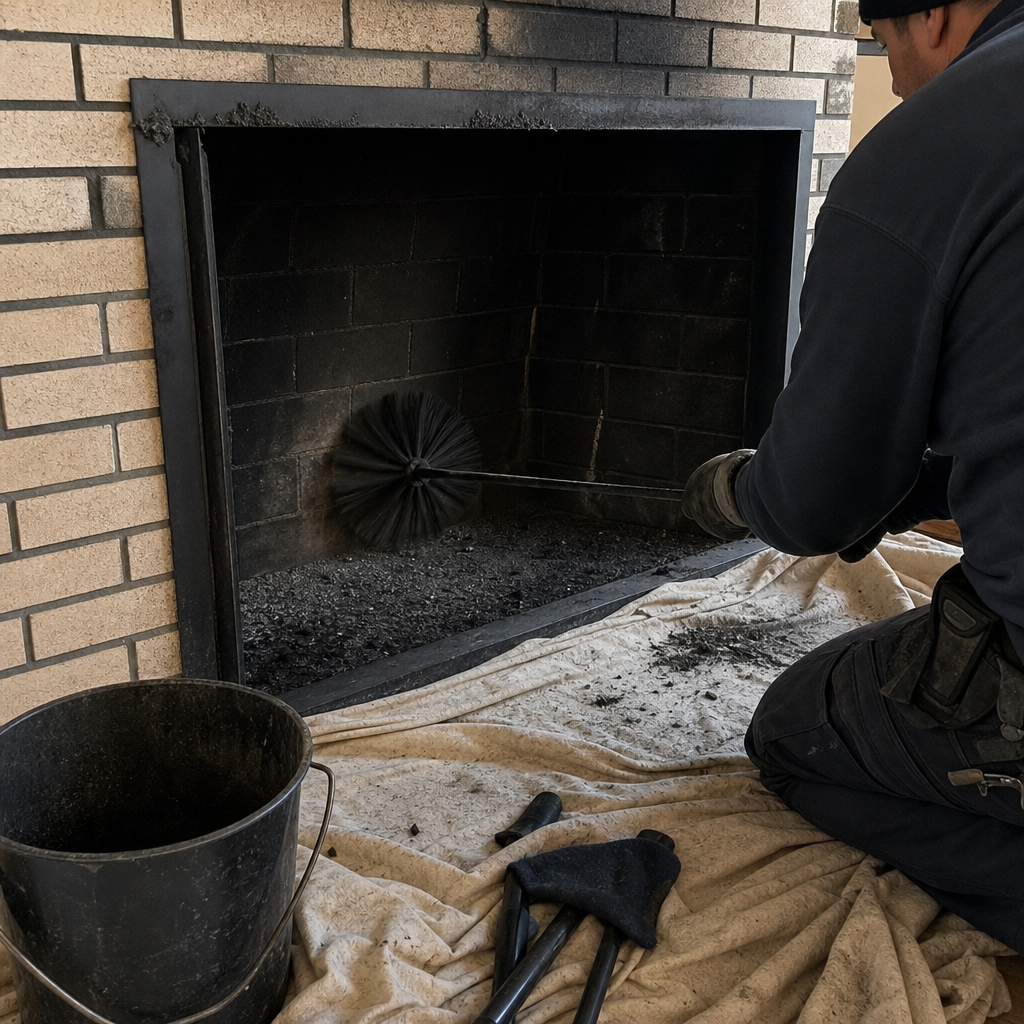
What Is Creosote Buildup? The Real Answer for New York Homeowners
Creosote buildup is condensed wood smoke that coats the inside of your chimney flue. It forms when smoke cools before it exits, causing tar particles and unburned hydrocarbons to stick to the walls and harden into layered deposits. In New York’s pre-war housing stock, oversized flues designed for coal burning create cooler drafts that accelerate this process dramatically.
Last February, Paul Torres pulled a full Stage 3 glazed deposit from a Park Slope brownstone flue that had been “swept” six months earlier by a cut-rate crew who never ran a camera. The homeowner had been burning the same oak he’d always burned. What changed wasn’t the wood — it was that nobody had accounted for his 9-by-13-inch flue running through an uninsulated exterior chase in a 1920s masonry stack. That geometry matters more than most sweeps will tell you.
If you’re noticing a tar smell when you light fires, or if it’s been over a year since your last Chimney Cleaning & Sweep, call Legacy Chimney Cleaning New York at (833) 349-5892 for a no-pressure flue inspection.
How Creosote Actually Forms — And Why Temperature Controls Everything
Wood doesn’t burn cleanly. Even dry hardwood releases volatile gases, water vapor, and microscopic carbon particles that ride the draft upward. In a properly sized, well-insulated flue running above 250°F, most of that exhaust stays hot enough to exit before anything sticks. Drop the wall temperature — through an oversized flue, a long exterior run, or cold outdoor air — and those same particles hit a surface cool enough to condense.
Think of it like breath on a cold window. The smoke doesn’t “turn into” creosote; it deposits because the flue became a condensing surface. Once that first layer adheres, it insulates the wall slightly, making the next layer easier to form. The cycle compounds.
Three variables determine how fast this happens:
- Flue temperature — the dominant factor; cooler walls equal faster buildup
- Wood moisture content — wet wood burns cooler and produces more particulate-laden smoke
- Chimney geometry — height, diameter, insulation, and exterior exposure all affect draft temperature
In New York, we regularly see two of these three factors stacked against the homeowner. Pre-war brownstones, row houses, and even many mid-century buildings in neighborhoods like Washington Heights and Astoria have flues that were engineered for coal — a hotter, denser burn that kept those larger passages warm. Drop a modern wood insert or even a traditional fireplace into that same oversized channel, and the draft temperature falls below the condensation threshold for significant portions of the burn cycle.
Paul Torres trained in HVAC and building systems technology at Bronx Community College before spending 14 years in the field, and he’ll tell you what he sees, not what sounds good: “Your flue doesn’t care what the listing agent called the fireplace. It cares about actual gas temperature versus wall temperature, and in a lot of these old New York stacks, that math doesn’t work in your favor.”
The Three Stages of Creosote — And What Each One Means for Your Chimney
Not all creosote is equally dangerous, but all three stages share one trait: they restrict your flue and increase fire risk. The difference is how fast they ignite and how hard they are to remove.
Stage 1: Sooty, Dusty, Brushes Off
Stage 1 creosote looks like gray-brown dust or fine flakes. It brushes away with standard poly or wire brushes during a routine Chimney Cleaning & Sweep in New York. Ignition temperature runs around 1,000°F — reachable during a chimney fire, but this stage itself doesn’t dramatically accelerate the risk. If you’re scheduling annual sweeps and burning properly seasoned wood, this is typically what we find.
Stage 2: Tar-Like and Porous
Stage 2 shifts to a crunchy, porous, black or dark brown deposit that resembles hardened tar or honeycomb. Standard brushing won’t touch it. We remove it with rotary whips, chains, or specialized mechanical tools — equipment that rides on flexible rods and physically abrades the buildup. Ignition temperature drops to roughly 700-800°F, which a sustained hot fire can achieve. This is where we start finding it in New York chimneys after a single heating season of wet wood in an oversized flue.
Stage 3: Glazed, Shiny, and Highly Combustible
Stage 3 creosote is the dangerous one. It appears as a hard, glossy, black or dark brown glaze — almost like obsidian — formed when fresh deposits repeatedly melt and re-harden under partial burns. This requires chemical treatment to soften before mechanical removal, or in severe cases, replacement of the flue liner itself. Ignition temperature falls to approximately 450°F, which a normal operating fire can reach. A Stage 3 deposit is a chimney fire waiting for its moment.
Here’s the progression that catches New Yorkers off guard: Stage 1 to Stage 3 in one winter. We’ve seen it in Crown Heights, in Inwood, in a converted carriage house in Red Hook. The homeowner burns weekend fires, buys “seasoned” wood from a sidewalk vendor in Queens that was split eight weeks ago, and runs it in a 100-year-old flue that never gets warm enough to self-clean. By March, we’re looking at glazed deposits that require chemical treatment with professional-grade products before we can safely remove them.
Why New York’s Housing Stock Makes Creosote Worse
This is the part most national explainers miss entirely. New York City’s building fabric creates structural conditions that accelerate creosote formation regardless of how careful the homeowner is.
Oversized flues are everywhere. Pre-war construction — and that’s most of the residential housing in Manhattan below 96th Street, brownstone Brooklyn, and large swaths of the Bronx and Queens — used masonry flues sized for coal-fired boilers and furnaces. A typical coal flue might run 8×12 inches or larger. Modern wood-burning appliances are designed for 6-inch or 8-inch round liners. When you burn wood in that oversized rectangle, the exhaust expands, cools, and slows. The walls stay cold. Condensation happens faster and across more surface area.
Exterior chases are common and uninsulated. Many New York chimneys run up exterior walls or through unconditioned attic spaces. In January, when outdoor temperatures hit the teens, those flue walls can drop below 100°F even with a fire burning. Every cubic foot of smoke that contacts that surface is a candidate for deposition.
Wood storage is a genuine urban problem. Seasoned firewood needs 6-12 months of covered, ventilated storage to drop below 20% moisture content. In a Brooklyn brownstone with no yard, a Queens apartment with a shared driveway, or a Washington Heights co-op with no storage allowance, that simply doesn’t happen. The cord wood sold on sidewalks and delivered by the bag in the five boroughs is frequently 30-40% moisture — green enough that a significant portion of the fire’s energy goes to boiling water rather than generating heat, and the resulting smoke is cooler and more particulate-heavy.
We inspected a chimney in Astoria last season where the homeowner was meticulous: he burned only on weekends, used a moisture meter, and thought he was buying seasoned wood. The meter read 18% on the surface. Paul Torres split a few pieces and tested the center: 34%. That internal moisture doesn’t show until the fire struggles and the flue fills with cool, wet smoke. By the time we arrived, his “careful” burning had produced Stage 2 deposits across twelve feet of flue.
What Professional Creosote Removal Actually Involves
When we inspect a flue, we run a camera from top to bottom before touching a brush. That footage goes to the homeowner. You’ll see exactly what we see — the stage, the thickness, the location of any problem areas. No guessing, no “trust me” assessments.
For routine Stage 1 buildup, a standard sweep with professional brushes and HEPA-contained vacuuming handles it. We typically complete this in 60-90 minutes for a single-flue chimney.
Stage 2 requires rotary mechanical cleaning. We bring chains, whips, and polypropylene heads sized to your flue diameter, run on flexible steel or nylon rods with a high-torque drill. This is physical work — the deposits don’t surrender easily — and it’s why having the equipment on the truck matters. Paul Torres has invested in the full rotary setup because sending a customer to a second contractor for “heavy cleaning” is exactly the kind of runaround he built Legacy to avoid.
Stage 3 glazed creosote demands chemical treatment first. We apply professional-grade creosote modifiers that penetrate and soften the glaze over a controlled period — sometimes 24-48 hours, sometimes longer depending on thickness and flue access. Once softened, we follow with mechanical removal. In severe cases where the deposit has compromised the liner or the liner was already deteriorating, we may recommend a new stainless steel liner installation using DuraFlex or Olympia Chimney components, properly sized to your appliance and insulated to maintain draft temperature.
The brands matter. We specify Gelco and Copperfield for caps and accessories, and Famco where ventilation components are involved, because these are the products chimney professionals use — not the generic versions that fail at the joints after two seasons of freeze-thaw cycling on a New York roof.
Can You Prevent Creosote Buildup?
Yes, partially. No prevention method eliminates the need for annual inspection and cleaning, but you can slow the accumulation significantly.
- Burn only properly seasoned hardwood — oak, maple, beech — with moisture content below 20%. Buy your wood a year ahead if you have storage, or use a kiln-dried product from a verified supplier.
- Build hot, fast-starting fires rather than slow, smoldering loads. A hot flue stays above the condensation threshold. An insulated liner helps maintain this temperature in marginal conditions.
- Don’t damper down overnight to “keep the coals alive.” Starving a fire of oxygen produces the coolest, dirtiest smoke — the exact conditions that create Stage 2 and Stage 3 deposits fastest.
- Have your chimney inspected annually by a technician who runs a camera and can show you the flue condition, not just report “it looks fine from the top.”
Even with perfect practices, New York’s structural realities — those oversized flues, those exterior chases — mean some creosote formation is inevitable. The question isn’t whether you’ll have buildup; it’s whether you’ll catch it at Stage 1 or let it progress to something that requires chemical treatment or liner replacement.
When Creosote Becomes a Safety Issue
Chimney fires from creosote ignition aren’t rare dramatic events. They’re often quiet, sustained burns that damage the flue liner and surrounding masonry without the homeowner realizing it. The signs can be subtle: a louder-than-normal draft, a hot smell in upper rooms, visible sparks or flame at the chimney top. Many homeowners mistake a chimney fire for “the fire just got really hot.”
After any suspected chimney fire, you need a Level 2 inspection — camera scan, accessible interior evaluation, and assessment of the flue liner’s integrity. Paul Torres has found cracked clay liners and displaced flue tiles after fires the homeowner described as “just a little pop and some sparks.” The damage was already done, and the next fire would have had a path to combustible framing.
We don’t recommend DIY creosote removal for Stage 2 or Stage 3 deposits. The mechanical force required risks damaging clay flue tiles, and chemical treatments require controlled application and ventilation. For Stage 1, a homeowner with proper equipment can maintain between professional visits — but in New York’s conditions, most chimneys need professional attention annually.
What Creosote Removal Costs in New York
Chimney Cleaning Cost in New York, NY depends on stage, accessibility, and whether liner work is needed. Here’s what Legacy Chimney Cleaning New York typically sees across the five boroughs:
| Service | Typical Range | What’s Included |
|---|---|---|
| Standard chimney sweep (Stage 1) | $180 – $280 | Full flue brushing, smoke chamber cleaning, HEPA vacuuming, camera inspection |
| Rotary mechanical cleaning (Stage 2) | $320 – $480 | Rotary whip/chain removal, camera verification, debris containment |
| Chemical treatment + removal (Stage 3) | $450 – $750 | Professional-grade creosote modifier application, follow-up mechanical removal, camera documentation |
| Stainless steel liner replacement | $2,800 – $5,500 | Insulated DuraFlex or Olympia Chimney liner, proper sizing, cap installation, permit coordination where required |
These are real ranges from actual New York jobs — not teaser rates that balloon on arrival. Paul Torres provides upfront pricing after inspection, not before he’s seen what your flue actually contains. The free estimate is exactly that: we’ll show you the camera footage, explain what stage you’re at, and quote the work required. No upsell to services you don’t need.
FAQs
With properly seasoned wood and a correctly sized, insulated flue, Stage 1 accumulation develops gradually over a full heating season. In New York’s older housing with oversized flues and wet wood, we’ve documented progression from clean to Stage 2 in as little as 20-30 fires — potentially a single winter of weekend use. Call (833) 349-5892 for a camera inspection if you’re unsure of your flue condition.
Removal is always cheaper if the liner is structurally sound — Stage 1 and Stage 2 cleaning runs $180-$480 versus $2,800+ for liner replacement. However, if glazed Stage 3 creosote has damaged the clay tiles, or if the flue was never properly sized for your appliance, liner replacement becomes the more cost-effective long-term solution because it corrects the underlying temperature problem. We’ll show you the camera footage and recommend honestly; call (833) 349-5892 for an assessment.
Stage 1 and most Stage 2 deposits, yes — we carry rotary equipment on every truck and can complete mechanical removal during the same visit. Stage 3 glazed creosote requires chemical treatment that needs time to penetrate before mechanical removal; this typically schedules as a two-visit process. Either way, you won’t need to call a second company — Legacy handles the full spectrum from Affordable Chimney Cleaning & Sweep in New York, NY to rebuild. Call (833) 349-5892 to schedule.
Pine doesn’t inherently create more creosote than hardwood at the same moisture content — the myth persists because pine is often burned wet and because it burns faster, encouraging users to damper down for longer burns. The real drivers are moisture content and flue temperature, not species. That said, in New York’s already marginal draft conditions, any wood below 20% moisture will accelerate buildup. For a moisture test and honest assessment of your burning practices, call (833) 349-5892.
Get an Honest Look at Your Flue
Creosote buildup isn’t a mystery, and it isn’t something you need to take on faith. At Legacy Chimney Cleaning New York, we run the camera, show you the footage, and tell you exactly what stage you’re at and what it will take to fix it. Paul Torres leads every job personally, with 14 years and 1,100+ reviews behind the work. From Best Chimney Cleaning & Sweep in New York, NY to full liner replacements with professional-grade materials, we’re the same call start to finish.
If you’d rather have it looked at, Legacy Chimney Cleaning New York offers a no-pressure assessment in New York — call (833) 349-5892.
Written by Paul Torres, Owner & Lead Technician at Legacy Chimney Cleaning New York, serving New York, NY.