
Signs Your Chimney Needs Cleaning in New York — Before the Smoke Starts
If you’re wondering whether your chimney needs cleaning, the honest answer is: most New York chimneys show subtle early warnings long before smoke backs into the room. Diminished draft on startup, a faint creosote smell on warm days when the fireplace is cold, and scratching sounds from an uncapped flue are the real first signals — not the dramatic symptoms most lists describe. We’ve spent 14 years inspecting chimneys across all five boroughs, and the homeowners who catch these early signs are the ones who avoid the expensive surprises. If you want certainty rather than guesswork, call us at (833) 349-5892 — we document everything we find with photos from inside your flue.
Why the Standard “Signs” List Fails New York Homeowners
Most articles tell you to watch for smoke pouring into your living room or black stains above the mantel. Paul Torres has a different take: if you’re seeing that, you don’t need a cleaning appointment — you need someone there today. Those are end-stage symptoms, not warning signs.
The real problem in New York’s housing stock is that chimneys here live harder lives than most. Pre-war row houses in the Bronx share chimney stacks between units. Brooklyn brownstones have flues that haven’t been properly inspected since the 1980s. Manhattan co-ops often have maintenance schedules driven by board politics, not by what’s actually accumulating up there. In Queens and Staten Island, the mix of salt air exposure, freeze-thaw cycles, and mature tree canopy creates conditions you won’t find in a suburban manual.
Last March, Paul was called to a co-op in the Bronx near Yankee Stadium — not far from where he grew up — where the tenant had zero complaints. No smoke, no smell, no performance issues. But a routine inspection revealed a partial blockage from a collapsed clay liner section that was channeling carbon monoxide into the shared wall cavity. The adjacent unit’s stronger draft was masking the problem entirely. That’s the kind of thing that doesn’t make it into generic “signs” articles.
Here’s what we actually look for — and what you can check yourself before calling anyone.
The Early Warning Signs Most Lists Miss
Diminished Draft on Cold Starts
Your fire should establish upward airflow within 30–60 seconds of lighting. If you’re holding a newspaper longer than that, waving it to get things moving, or noticing a slight haze in the firebox during the first few minutes, your flue is struggling. In New York’s older masonry chimneys, this often means creosote buildup has narrowed the passage, or the flue liner has developed gaps that disrupt the Venturi effect.
We see this constantly in Brooklyn Heights and Park Slope brownstones where homeowners burn weekend fires all winter. By February, that weekly accumulation has formed a measurable restriction. Paul Torres checks draft with a manometer on every inspection — we’ll tell you the actual pressure reading, not just “it seems fine.”
The Creosote Smell on Warm Days
This one’s counterintuitive but reliable. When outdoor temperatures rise above your flue temperature — common in New York’s unpredictable spring and fall — any creosote deposits begin to off-gas. You’ll catch a faint petroleum or tar-like smell near the fireplace, even though it hasn’t been used in weeks.
This isn’t cosmetic. Stage 2 creosote (the shiny, brittle coating) and Stage 3 (the hardened, glaze-like layer) are both flammable. The National Fire Protection Association reports creosote ignition as a leading cause of chimney fires nationwide. In New York’s dense housing, a chimney fire doesn’t just threaten your unit — it threatens the attached properties on either side. We’ve responded to calls in Astoria and Washington Heights where neighbors smelled the fire before the homeowner knew anything was wrong.
Scratching, Tapping, or Rustling from the Flue
Birds, squirrels, and raccoons view an uncapped chimney as ready-made real estate. In Manhattan and the Bronx, where mature trees meet masonry housing stock, we remove nesting material from flues year-round. The sound is distinctive — rhythmic, localized, often worse in early morning.
Here’s the critical detail: nesting material doesn’t just block airflow. It holds moisture against the liner, accelerates deterioration, and can harbor parasites. We use Gelco and Famco chimney caps on installations because their mesh design excludes animals without restricting draft. If you’re hearing movement up there, the cap either failed or was never installed properly.
Soot Falling into the Firebox
Granular black debris on the hearth or firebox floor means something above is deteriorating. It could be flaking creosote, crumbling masonry, or degraded liner material. In pre-war New York construction with unlined or partially lined chimneys, this is especially common after freeze-thaw cycles — which means you’re likely seeing it in late winter or early spring.
Paul documented this exact pattern in a 1920s Tudor in Forest Hills last year. The homeowner assumed it was “just soot.” It was actually spalling parging from a deteriorated smoke chamber, creating a pathway for combustion gases into the framing. We ended up doing a full Chimney Cleaning & Sweep plus smoke chamber parge with HeatShield refractory mortar. The “cleaning” was the smallest part of the job — but the inspection that found the real problem was what mattered.
How to Check Your Chimney Yourself — The Flashlight and Mirror Method
You don’t need special equipment to get useful information. Here’s what Paul Torres teaches homeowners who want to understand their own system before calling anyone:
- Wait 24 hours after any fire. The flue must be completely cool. This isn’t negotiable — creosote can re-ignite if disturbed while warm.
- Open the damper fully. Shine a bright flashlight up the flue from the firebox. A mechanic’s inspection mirror helps angle the view, but even a phone flashlight held at arm’s length reveals plenty.
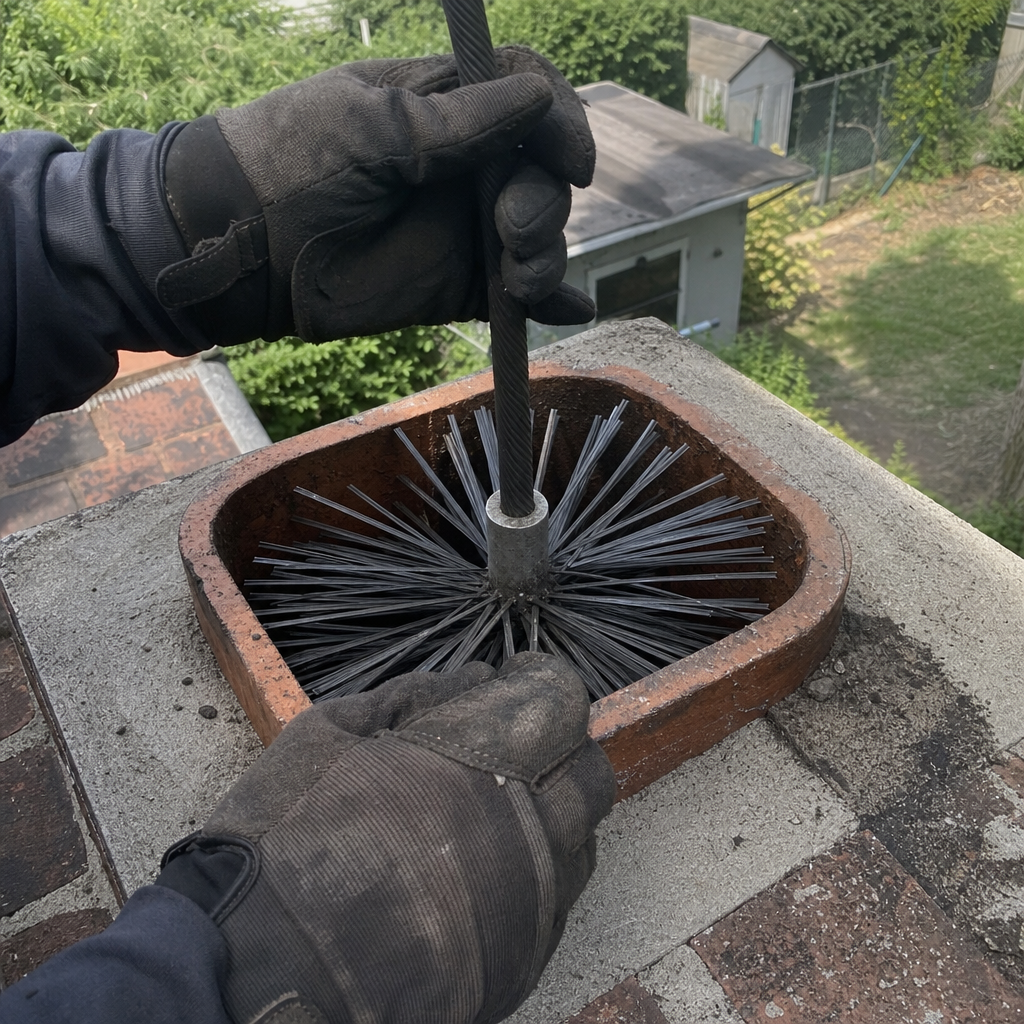
- Look for glaze. Stage 3 creosote appears as a shiny, black, enamel-like coating. It reflects light differently than bare masonry or normal soot. If you see it, stop looking and call a pro — this requires rotary cleaning equipment, not a brush.
- Check for debris. Leaves, twigs, or nesting material will be obvious. Don’t reach for them — some animals are protected, and disturbing a nest improperly can create worse problems.
- Inspect the liner. If your chimney has a stainless or clay tile liner, look for gaps, cracks, or displaced sections. Any visible damage means the system is compromised regardless of how clean it appears.
- Note the color. Normal flue surfaces range from light gray to black. White or yellow staining indicates moisture intrusion and chemical reaction — that’s a different problem than cleaning, but equally urgent.
What you’re doing here is gathering information, not solving the problem. If you find anything beyond light, powdery soot, you need a professional evaluation. The home page has more about our inspection process, but the key point is this: we’ll show you exactly what we found, with photos from inside your flue, before we recommend any work. Paul Torres built this business on that transparency. “I’ll tell you what I see, not what sounds good” — that’s the standard every job gets.
The “I Don’t Use My Fireplace” Misconception
This comes up constantly in New York, where many homeowners treat their fireplace as decorative. Here’s the reality: an unused wood-burning chimney still accumulates debris from wind, animal intrusion, and building envelope deterioration. Moisture enters through failed crowns or uncapped flues. Freeze-thaw cycles degrade mortar joints. We’ve found significant blockages in “unused” chimneys in the West Village and Upper East Side that hadn’t seen a fire in years.
Gas fireplaces create their own byproducts — water vapor, carbon monoxide, and in some cases sulfur compounds that corrode metal liners. The flue still needs clear passage and intact construction. A gas fire doesn’t produce creosote, but it absolutely can reveal (or create) venting problems that a cleaning inspection would catch.
Building code in New York City requires chimneys, vents, and flues to be maintained in safe operating condition regardless of frequency of use. Your insurance policy likely has similar language. The “unused” defense doesn’t hold up after a fire or carbon monoxide incident.
Why Shared Chimney Stacks Hide Problems
This is the New York-specific factor that generic advice never addresses. In row houses, townhouses, and many co-op buildings, multiple units share a common chimney structure with separate flues. When one unit has strong draft and another has partial blockage, the pressure differential can mask symptoms in the compromised flue.
Paul found this exact scenario in a Mott Haven row house two winters ago. The first-floor tenant reported perfect fireplace performance. The third-floor unit — same chimney stack, separate flue — had a partially collapsed clay liner that was venting into the masonry cavity. Without a dedicated inspection of each flue, there was no way to detect the problem. The first-floor draft was literally pulling the evidence away from the third-floor tenant’s notice.
If you live in attached housing in New York — and most of us do — your chimney’s performance isn’t just about your unit. It’s about the entire stack’s condition and the interaction between flues. That’s why our inspections include the full structure, not just “your” flue in isolation.
What Professional Cleaning Actually Includes — and What It Costs
When we say “chimney cleaning,” we’re describing a complete service, not a quick brush-and-vacuum. Here’s how Paul Torres structures every job:
| Service Component | What’s Included | Typical Range in New York |
|---|---|---|
| Level 1 Inspection | Visual examination of accessible portions, firebox, damper, smoke chamber, flue interior | $150–$250 |
| Standard Sweep (open fireplace) | Rotary or manual brushing of flue, debris removal, firebox cleaning, damper maintenance | $200–$350 |
| Heavy Creosote Removal (Stage 2/3) | Mechanical rotary cleaning, chemical treatment if needed, multiple passes | $350–$550 |
| Insert or Stove Cleaning | Disconnection (if applicable), flue liner cleaning, baffle and component service, reassembly | $275–$425 |
| Documentation Package | Before/after photos from flue interior, written condition report, repair recommendations | Included with all Legacy services |
These ranges reflect New York’s labor costs, parking and access challenges, and the condition of our aging housing stock. We’re not the cheapest call, and we don’t try to be. What you get is Paul Torres on every job, 14 years of documented experience, and a photo record you can reference for insurance, resale, or your own peace of mind.
We work with Olympia Chimney stainless liners and HeatShield resurfacing systems when repairs follow cleaning — professional-grade materials specified by chimney professionals, not whatever’s in stock at the hardware store. From the sweep to the rebuild, it’s the same crew, same accountability, same standard.
Key Takeaways: When to Call Legacy Chimney Cleaning New York
- Before symptoms appear: Annual inspection is the standard for active fireplaces, every 2–3 years for gas or unused wood systems.
- At the first subtle sign: Hard starting, odd smells, or sounds from the flue mean something is already developing.
- After any change: New appliance, new fuel type, or visible debris means an immediate check is warranted.
- In shared buildings: Your flue’s performance depends on the full stack — don’t assume no symptoms means no problems.
- Always: If you see glaze in your self-check, stop and call a pro. Stage 3 creosote is not a DIY situation.
FAQs
A standard chimney sweep and Level 1 inspection in New York typically runs $200–$350 for an open fireplace, with heavy creosote removal ranging $350–$550 depending on buildup severity and flue accessibility. Call (833) 349-5892 for an exact quote on your specific system — estimates are free, and we’ll tell you upfront if your situation is standard or needs additional attention.
Light soot removal with proper brushes is possible for knowledgeable homeowners, but Stage 2 or 3 creosote requires mechanical rotary equipment and professional training to remove safely — incorrect technique can damage liners or leave dangerous deposits intact. Given New York’s older housing stock and the prevalence of degraded clay liners, we recommend professional evaluation at minimum before any DIY attempt. Call us for a no-pressure assessment if you’re unsure what you’re dealing with.
The National Fire Protection Association recommends annual inspection for all chimney systems, with cleaning frequency determined by use and fuel type — typically annually for regular wood burning, every 2–3 years for occasional use or gas systems. In New York specifically, Paul Torres advises annual service for active wood-burning fireplaces due to our freeze-thaw cycles, shared chimney structures, and the age of our housing stock. Call (833) 349-5892 to schedule based on your actual usage pattern.
Repair with refractory resurfacing or stainless steel relining is almost always more cost-effective than full reconstruction, provided the masonry shell remains sound — resurfacing runs roughly 30–50% of replacement cost for localized damage, while full stainless relining typically ranges $2,500–$5,000 in New York versus $8,000–$15,000+ for tear-down rebuild. Paul Torres evaluates liner condition with video inspection on every cleaning call, so you’ll know exactly which category you’re in before any commitment. Call (833) 349-5892 for a documented assessment with photos.
Get an Honest Look at What You’re Burning Over
If you’d rather have certainty than guesswork, Legacy Chimney Cleaning New York offers a no-pressure assessment anywhere in New York — Paul Torres leads every job personally, documents everything with flue-interior photography, and explains what he found in plain language before any work begins. We’ve built this business across 14 years and 1,119 reviews by being the best chimney cleaning and sweep in New York, NY — the one who shows you the problem, not just the invoice. Call (833) 349-5892 for your free estimate.
Written by Paul Torres, Owner & Lead Technician at Legacy Chimney Cleaning New York, serving New York, NY.